
How do I apply penalties and rewards to employees fairly, without arguments?
| Intagya ERP
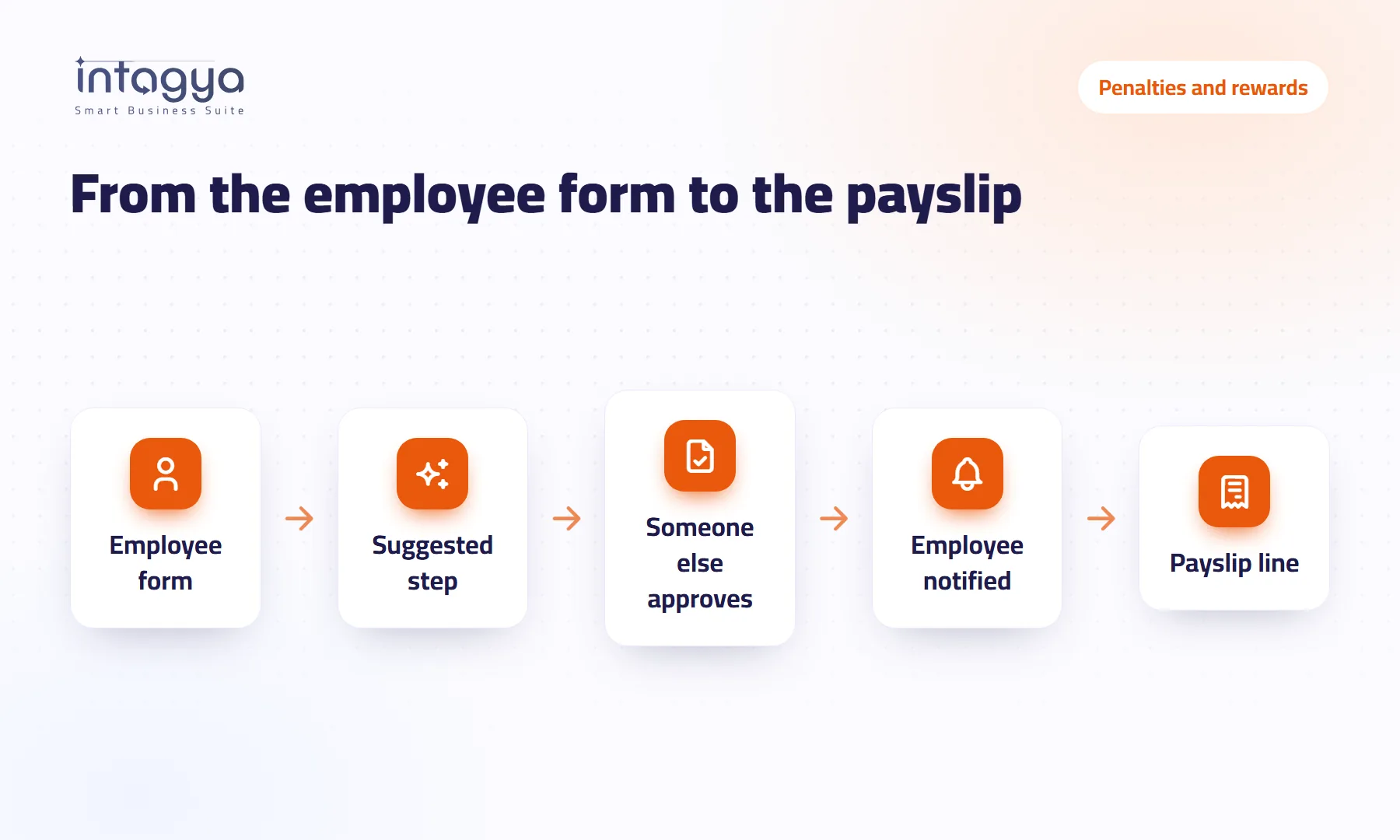
Write the rule down before you need it: every violation has a known ladder that starts with a notice, then a warning, then a deduction of part of a day. Record the penalty on the day it happens, not at the end of the month, let someone other than the recorder approve it, and tell the employee as soon as it is approved. In Intagya ERP this happens on the employee form: the system suggests the step from how many times it happened, computes the amount from the wage, and the penalty or reward reaches the month's payslip without anyone typing it again.
On the 14th the sales rep came in 45 minutes late. The manager told the accountant: take a quarter day off his pay. The accountant wrote it on a slip of paper. On the 30th payroll came round and the slip was in another drawer. The full salary went out, the manager remembered, the quarter was taken from the next month, and the rep was angry because he had never heard about it.
The deduction itself was fair. The way it travelled ruined it.
Why does a small penalty turn into a big argument?
For three reasons that come up in almost every company. The penalty is decided by the mood of the moment, so one employee gets a notice and a colleague gets a day's deduction for the same mistake. It is recorded late or not at all, and gets lost between the manager and the accountant. And the employee is the last to know, finding out from the payslip.
My view: do not start with the deduction. Start with the written rule.
What ladder will employees accept?
One that is known in advance, from the day they are hired. For lateness, for example: the first time a notice, the second a written warning, the third a quarter day, the fourth half a day, the fifth a full day. The count restarts after six months, so someone late twice in January is not punished for it in November.
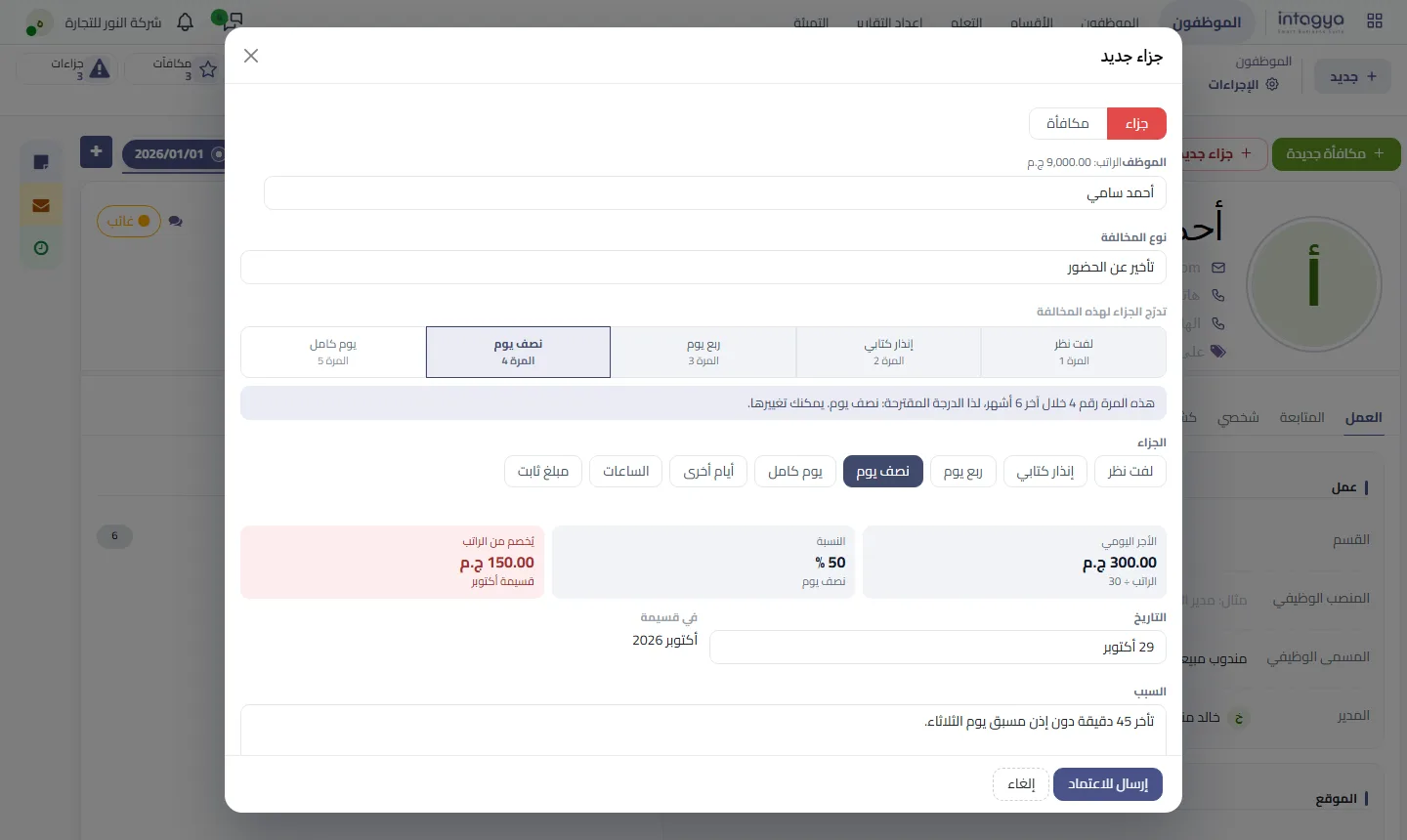
In Intagya ERP every violation type has its ladder. When you open the employee form, press "New Penalty" and pick "Lateness", the system counts the earlier times, highlights the suggested step and computes the amount from the wage: daily wage = wage / 30, so a quarter day of a 9,000 wage is 75. You can pick another step or a fixed amount, but the suggestion is in front of you, so it does not depend on anyone's memory.
Who approves the penalty?
Not the person who recorded it. This is the most important rule in this article.
When the manager records it, HR approves it. When HR records it, the employee's manager approves it. That way no single person decides and carries out alone, and every penalty has two pairs of eyes. A refusal needs a written reason, and once approved a penalty is not quietly edited: its cancellation is requested and that stays in the record.
When does the employee find out?
As soon as it is approved, not on payday. They get a notice in the system and on their phone: the violation, the time number, the reason and the amount taken from this month's salary. They see their whole record in "My Penalties and Rewards". What is not approved yet they do not see, so they never hear about something that may be refused.
It may sound harsh. It is the opposite: an employee who knows the same day corrects the behaviour the same week.
And what about rewards?
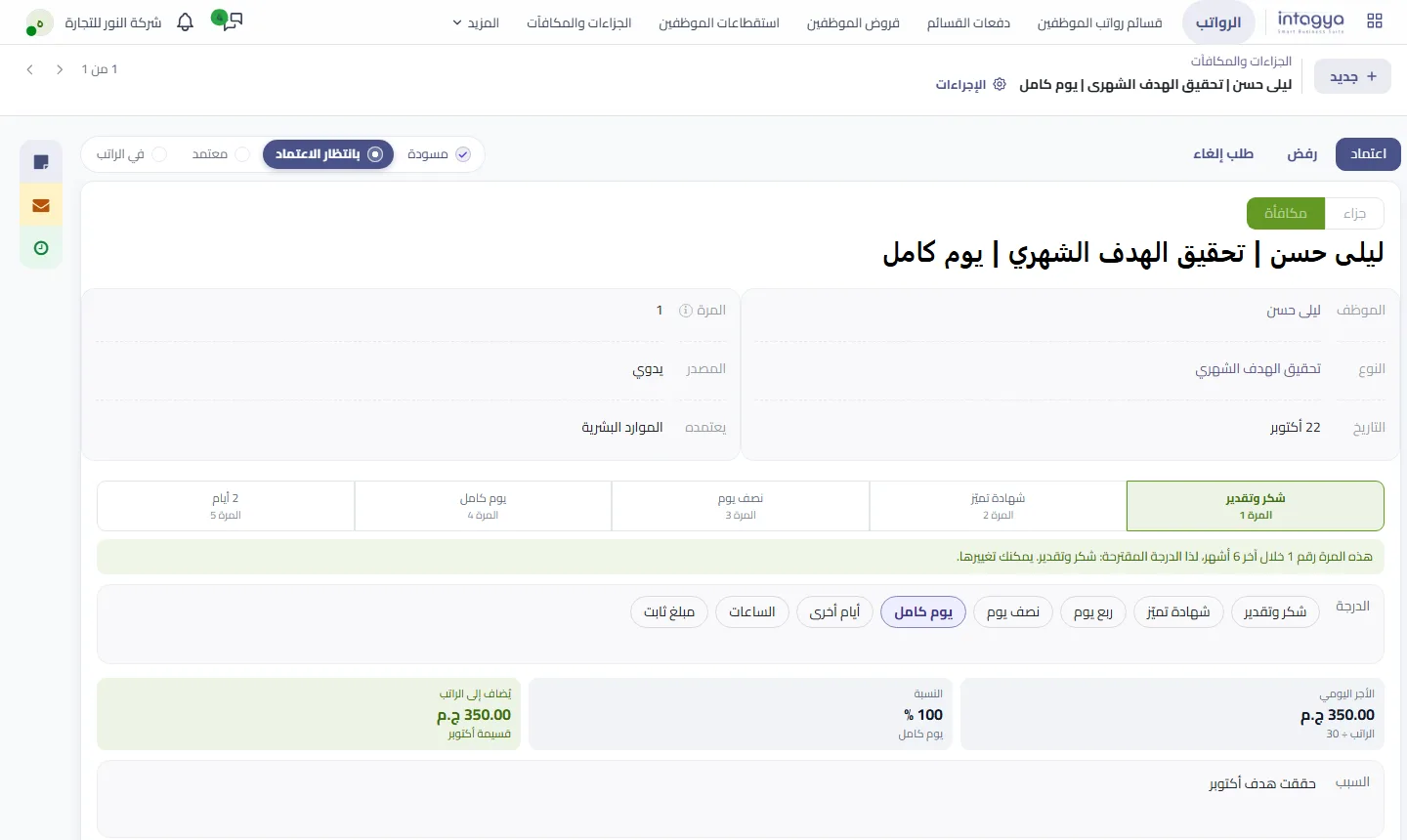
Exactly the same way, on purpose. A reward for hitting the month's target goes through the same kind of ladder: thanks, then a certificate of excellence, then half a day, then a full day. It is approved, notified and added to the payslip. Sales commissions can turn into a reward waiting for approval when their period ends, without anyone collecting them from a spreadsheet.
A company that records only penalties teaches its people that the system watches them. A company that records rewards just as carefully teaches them that it sees them.
Can the system record lateness and absence by itself?
Yes, if you want it to. One hour after each employee's day starts, the system compares the attendance with their schedule: anyone late beyond the grace time gets a lateness record, and anyone who did not come and has no time off gets an absence. All of them wait for the manager's approval, so nothing is deducted automatically. If the employee checks in after the check, the absence becomes lateness; if time off is approved later, the absence gets a cancel request. Timesheet hours above eight become an overtime reward waiting for approval.
An honest warning: do not switch automatic recording on before you are sure the schedules and the attendance device are right. A system that records an absence for someone who was out on a site visit loses people's trust in a week.
How does it show on the payslip?
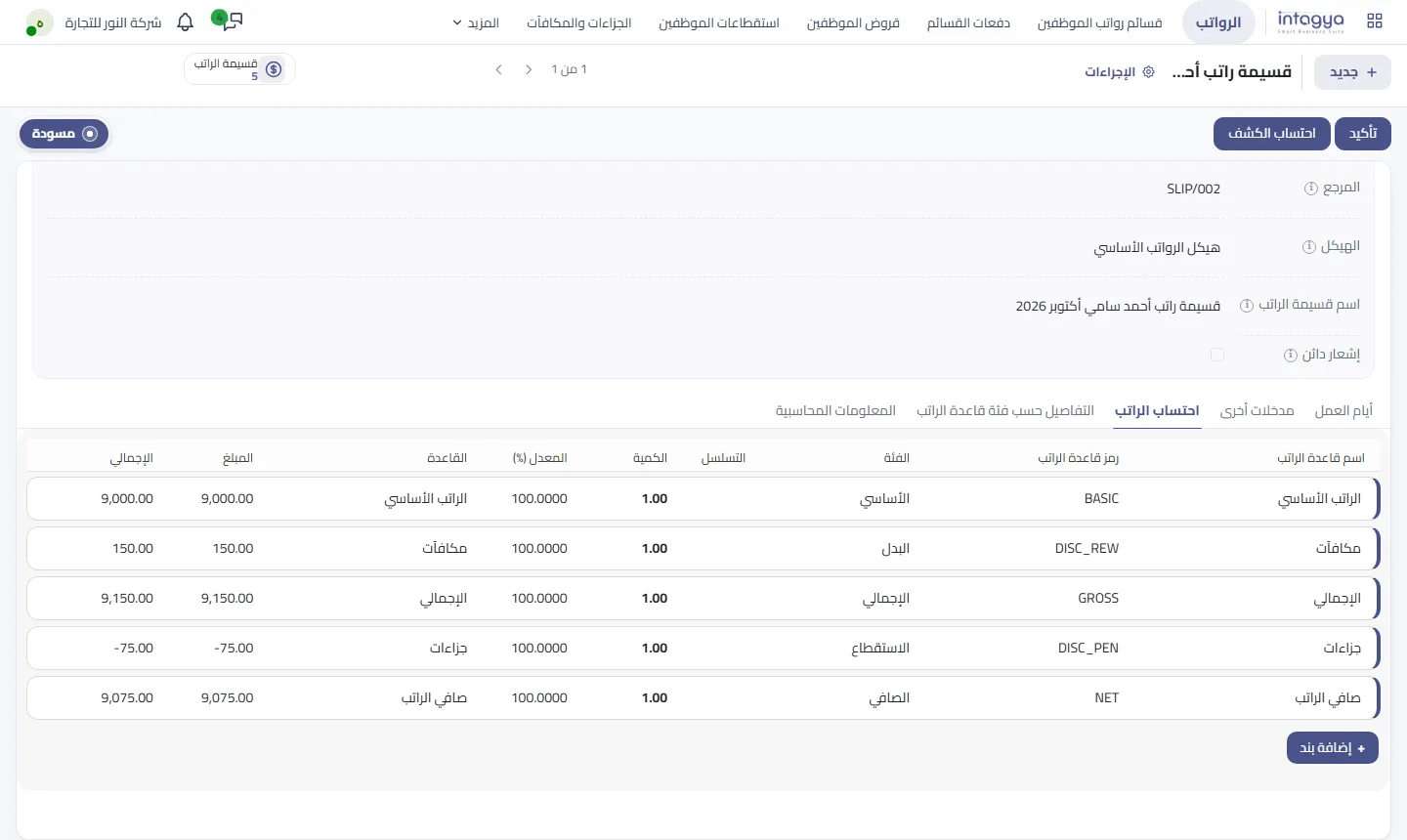
The month's payslip has two clear lines: "Rewards" added and "Penalties" deducted. A 9,000 salary with a half-day reward and a quarter-day penalty nets 9,075. No slip in a drawer, no deduction from next month, no surprise.
What should I do tomorrow morning?
Write one ladder only: lateness. Three or five steps, a grace time, and a period after which the count restarts. Show it to your team in a short meeting before you apply it. Record the first case from the employee form and let HR approve it. A month later add rewards, and after that think about automatic recording.
Penalties and rewards are part of HR and payroll in Intagya ERP, working with attendance, time off and payslips on the same data. The steps with pictures are in the user guide.
Read the penalties and rewards steps with pictures in the user guide
FAQ
Is a penalty deducted automatically without anyone seeing it?
No. Every penalty or reward, even one the system records by itself, waits for approval by someone other than the recorder, and does not reach the payslip before that.
Can I deduct a quarter day, half a day or a fixed amount?
Yes. You pick a quarter day, half a day, a day, several days, a fixed amount or hours with a factor, and the system computes the amount from the employee's wage.
When does the employee learn about the penalty?
As soon as it is approved, through a notice in the system and on their phone, and they see it in "My Penalties and Rewards". What is not approved does not show to them.
If we record a penalty mid-month, which payslip does it reach?
The payslip of the month the penalty's date falls in, on its own "Penalties" line, apart from other deductions.
Is this your business?
Want to see IntagyaERP on your own workflow?
Book a demo, tell us how your business runs, and watch the system handle a real scenario from your company.
Book a demo