
Why does my company show a profit when there is no cash?
| Intagya ERP
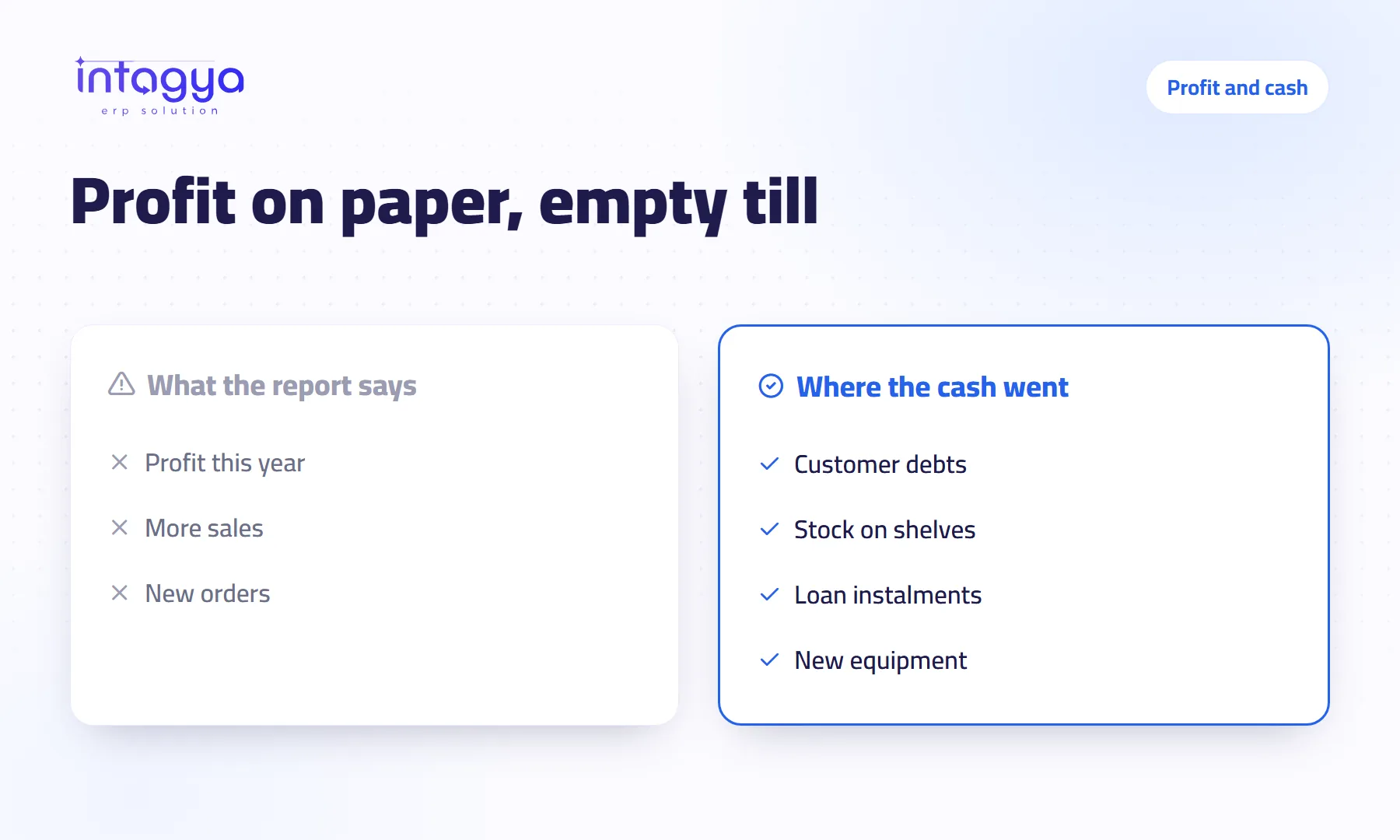
You make a profit on paper with an empty till because profit is counted when you sell, while cash arrives when you collect. The gap usually hides in three places: invoices customers have not paid, stock you bought and have not sold, and payments that are not expenses, such as loan instalments and new equipment. Put the profit and loss report next to the cash book and the aged receivables to see where the money went.
The owner of a small furniture workshop sits with his accountant at the end of the year. The report says the business made a profit. So he asks: then why did I borrow last month to pay salaries? The accountant has no quick answer, because the answer is not in one report.
Can a company be profitable and still have no cash?
Yes, and it happens a lot. Profit is an accounting figure: sales minus their cost and your expenses. Cash is what actually came into the till and the bank, and what went out.
When you sell a table on credit today, its profit shows in this month's report. The money may come in three months. Meanwhile you have paid for the wood, the workers and the rent.
Fast-growing businesses fall into this more than anyone. Every new order needs money before it brings money back.
Where does the profit go if it is not in the bank?
Look for it in these places, roughly in this order:
- Customer debts: invoices issued, profit counted, cash not collected.
- Stock: goods and raw materials you paid for that are still on the shelf.
- Loan repayments: the instalment leaves the bank, but the principal is not an expense, so it does not reduce profit.
- Assets: a van or a machine paid for today and expensed over years.
- Owner drawings: what the owner takes out never shows in profit and loss.
The first one is the biggest in most companies I see. Not because customers refuse to pay, but because nobody chases them on the due date.
Which report tells me the truth about my money?
No single report tells you everything. You need three, and each answers a different question.
Profit and loss answers: is my business profitable? The cash book and bank book answer: how much really came in and went out? The balance sheet answers: where is the money sitting now? In receivables, in stock, or in assets.
If profit is healthy and receivables on the balance sheet grow with it every month, you have found your missing profit.
How do I see which customers are holding my money, and for how long?
With the aged receivables report. It shows what each customer owes, split by age: not yet due, one month late, two months, and older.
Read the last column first. A debt older than three months rarely gets paid by waiting. It needs a phone call today, an instalment plan, or a decision to stop selling on credit to that customer.
Give each customer a credit limit that fits their size, and read the aged receivables every week, not once a year.
Is a full warehouse a good sign or a problem?
Many shop owners feel safe when the warehouse is full. But every item on the shelf is money that has not come back yet.
A made-up example: a spare parts trader buys a big quantity of one part because the supplier offers a discount. The discount saves a little, and the part sits there for a year. All that year the money is stuck on a shelf instead of paying salaries or buying what sells fast.
I am not saying never buy in bulk. I am saying know the value of your stock and compare it with what you really sell each month.
What can I do this month to improve cash?
- Open the aged receivables and call the five biggest overdue amounts.
- Check the aged payables and agree supplier due dates that fall after your collection dates, not before.
- Stop reordering items that have not moved for months.
- Record your personal drawings in their own account so you can see them.
This will not fix everything in a month. It turns “where is the money?” into a list of names and amounts you can act on.
How does Intagya ERP show profit and cash side by side?
In Intagya ERP every financial report sits under one “Financial Reports” menu: profit and loss, balance sheet, cash book and bank book, aged receivables and aged payables. You open them on screen and export to PDF or Excel. Because invoices, payments, purchases and stock live in one system, the figures come from the work itself, not from a sheet filled in at month end. The company dashboard also puts unpaid invoices in front of you every morning.
Tomorrow morning, open just two reports: this year's profit and loss, and the aged receivables. Put them side by side. The gap between them will tell you more than your bank balance does.
FAQ
Are profit and cash flow the same thing?
No. Profit is counted when you sell and incur costs; cash moves when you collect and pay. They can differ a lot in the same month.
Does repaying a loan reduce my profit?
Interest is an expense and reduces profit. The principal does not, but it still leaves the bank and reduces cash.
How often should I review customer debts?
At least weekly if you sell on credit. A yearly review comes too late.
Can I export these reports for my outside accountant?
Yes, every financial report in Intagya ERP exports to PDF or Excel.
Is this your business?
Want to see IntagyaERP on your own workflow?
Book a demo, tell us how your business runs, and watch the system handle a real scenario from your company.
Book a demo